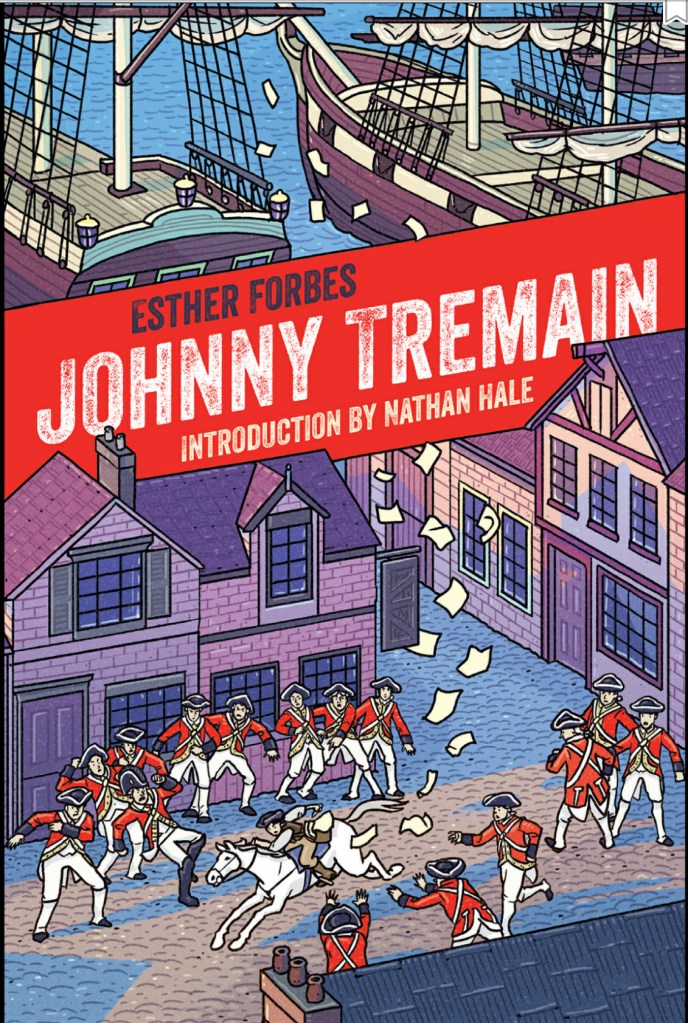
Title: Johnny Tremain: A Story of Boston in Revolt
Author: Esther Forbes
Published by Clarion Books
Edition: 75th Anniversary ed. edition (September 11, 2018)
Format Read: Kindle
Pages: 323
Language: English
ASIN: B07FK993XT
First Published by Houghton Mifflin in 1943
Dates Read: 2024, May 30 to June 16
Sometime in 2023, I developed an interest in the 18th century, especially Colonial America. I don’t remember the exact reason why I gained this sudden interest, but it may have to do with how I’m constantly seeing pins on Pinterest of portraits and clothing from those eras. Additionally, I have been trying to find novels about male friendships and adventures.
I remembered hearing about this book in elementary school, but I had never seen the movie. I knew that the novel is a Newbery Award winner. In college, I had to write a paper on the Newbery award. Although I had not read it, I used a line from the book because I needed more primary sources related to my paper’s topic. Also, I knew that there is a song in the movie about a tree that my parents would randomly sing. Finally, I became curious to actually read Johnny Tremain.
In this edition, there is a comic at the beginning that introduces the characters and a brief overview of the novel’s setting. It does not reveal huge spoilers which is helpful for people reading this story for the first time. First of all, the protagonist is much, much different than I thought. Based on my experience with retro media, I assumed that Johnny was going to be a goody-two-shoes, archetypal, heroic school boy— naive, innocent, and extremely lovable in every way. He may have been a bit like Dick from the Dick and Jane books, the brothers from Leave It to Beaver, or Opie from The Andy Griffith Show. Instead, the boy is so full of pride and angst— angst and pride— he goes back and forth. He is a bit hot-headed, and teases plenty, but he does grow during the course of the novel.
Since the book was written in the 1940s, and there are black characters, I was expecting the stereotypes to be cringy, and they are, just a little. I thought it was odd that the author used “black” but never “Negro” and seldom “colored”. I assumed in the ‘40s or 1770s colonial era that these were the terms used, and that “Black” wasn’t used regularly until the 1970s, along with “African American.”
I thought there would be some Indigenous characters, even if they were characterized flatly or stereotypically. However, there are none that I recall, but I could have sworn that it was going to be revealed that Rab is part Native American. This is due to the way that he is described with elements like: “dark boy,” “muscular, brown throat,” “teeth look sharp and white,” “calm demeanor,” and an odd last name, Silsbee, which sounds like a tribe (although the name is of English origin). It’s like the author is trying to hint at something— that he is not completely white—but it’s never stated. Johnny’s immaturity and angst contrasts with Rab’s collected, methodical, cool outlook, and their differences go together well as good friends. To me, the narrator relays Rab as almost perfect. His portrayal throughout the plot and what happens to him at the end of the story displays that he is almost the hero character and an ideal. The way Johnny idolizes Rab, despite some annoyance and jealousy at his actions, and seems to like him more than Cilla, displays such a deep, endearing friendship.
There is actually quite a bit of humor in this story, despite the fact that the plot culminates in a war. I enjoyed the episodic nature of the story and the slice-of-life adventures of Johnny, which saturate the reader in the setting’s world and provide ample characterization. I was especially surprised at the relay of the Boston Tea Party; it was like manual labor, an arduous task, not a feel-good party with dancing and craziness. How much early American history did I forget? The speech against tyranny and what they are trying to do right before the start of “The Scarlet Deluge” chapter definitely reminds me of WWII and other parallels. I liked this book, and I’m glad I finally read it, especially this version— and not the other published book with the boy and blue background. When I read the beginning of that one after finishing this novel, that introduction spoiled the entire novel, so I was happy to find a version to read without many major spoilers.
 A Love So Wordy