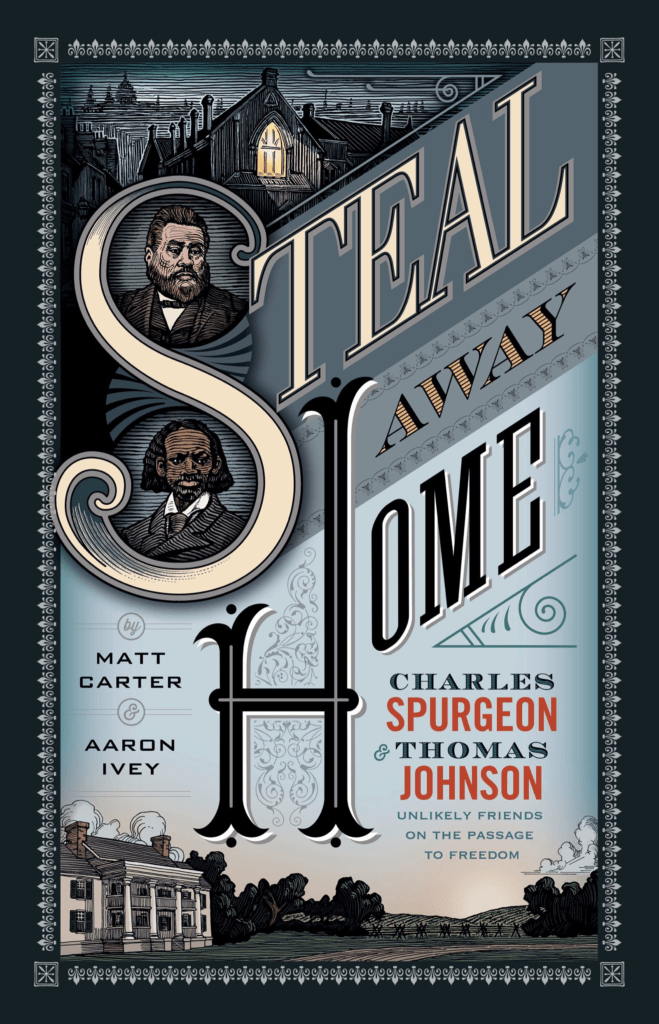
An Appraisal of the Christian Novel, Steal Away Home

Title: Steal Away Home: Charles Spurgeon and Thomas Johnson, Unlikely Friends on the Passage to Freedom

Author(s): Matt Carter and Aaron Ivey

Published by B&H Publishing Group, Nashville, Tennessee

Year: 2017

Pages: 272

Format Read: Kindle 

Language: English

ISBN: 978-1-4336-9065-5

I enjoyed reading this! In the introduction, the authors discuss their inspiration and research. They explain that the book has a high degree of historical accuracy with some liberties taken where necessary to fill in the blanks. This is a very moving Christian historical fiction novel. 

The book begins with the two main characters’ youthful days in the 1840s and progresses through to their mid to later life in the early 1890s. Growing up in England, Spurgeon has a loving and devout Christian family. However, at times, he struggles with depression and unwanted sinful thoughts. Johnson grows up as a slave on a plantation in Richmond, Virginia. He is separated from his family at an early age, and he deals with mistreatment. The book describes how they find Jesus who helps them overcome issues in life. Throughout the novel, God mightily puts people around them to encourage their spiritual growth and comfort them during struggles. The authors alternate back and forth conveying both characters’ progression and key events in their life, how they meet, and their perceptions. The authors are able to convey God’s sovereignty and faithfulness. Spiritual warfare in a believer’s life is clearly demonstrated.

I only knew that Spurgeon was a famous British preacher and that a lot of evangelicals in the USA admired his life and sermons. One of the many things that this book displays is how he is aware of the social ills in society (Victorian era) and the actions he takes to help downtrodden, poor people. A key event that is discussed is the tragedy at Surrey Hill which I have heard of or read about in a Christian publication. 

I had never heard of Thomas Johnson until I picked up this novel. He is super interesting as well. The writers express how he is tormented by fear, grief, loneliness as a slave and how he hates being in bondage; however he hears the gospel when his friend is secretly preaching in a cabin one night. Although Thomas still wants to be freed from slavery, he finds peace and comfort in Jesus. His thoughts are no longer full of hatred. I didn’t realize that “Steal Away” is a real hymn. The slaves whisper sing this the night that Thomas visits that cabin and hears the gospel. Later on, he sings this with the Spurgeons.

Spurgeon constantly preaches against slavery. An intriguing event that this novel covers is how Spurgeon’s writings were burned in book burnings in the American South due to his strong abolitionist stance. Johnson first hears of Spurgeon from his plantation owner and a Baptist preacher angrily discussing him and making Johnson drive them to one of the book burnings. This was fascinating to read in the novel, and I looked up this information later online.

After Johnson’s emancipation after the Civil War, the historical novel discusses how he meets his wife Henrietta, that he becomes a pastor, and has a desire to improve in his knowledge of the Word in order to take the gospel to his homeland Africa. He befriends a British businessman who makes a way for him and his wife to go to England and study at the college that Spurgeon established.

Thomas and Henrietta finally get to meet Charles and Susannah in the Spurgeon home, and they are able to fellowship together; they become friends. Henrietta and Thomas are finally able to go to a country in Africa, but he returns to the United States and England after she passes. Charles and Susannah deal with bouts of ill health. They continue to encourage each other. Thomas is one of Charles’ friends at his deathbed in France.

Although I liked this novel a lot, I wish that there was more interaction with Spurgeon’s twin boys Charles and Thomas. They are mentioned a few times but there is barely, if any, dialogue or description of them. Anyway, this was a beautifully written Christian historical fiction novel.

Dates Read August 15 to August 28 2021

A good, comprehensive article with more details about Johnson and Spurgeon’s life:

“Let the Dear Man Come”: C. H. Spurgeon’s Influence on Thomas Lewis Johnson (1836–1921), a Freed Slave, Former Student and Forgotten Missionary
Thoughts on Robinson Crusoe

The Life and Strange Surprizing Adventures of Robinson Crusoe, Of York, Mariner: Who lived Eight and Twenty Years, all alone in an un-inhabited Island on the Coast of America, near the Mouth of the Great River of Oroonoque; Having been cast on Shore by Shipwreck, wherein all the Men perished but himself. With An Account how he was at last as strangely deliver’d by Pyrates, also known as Robinson Crusoe

Author: Daniel Defoe

First Published in 1719 by William Taylor

Edition Read: Barnes & Noble Classics Hardcover Edition Published in 2004

266 Pages including the Introduction,Notes, etc.

English Language

ISBN-13: 978-59308-169-0ISBN-10: 1-59308-169-3

I have had this book on my bookshelf for probably a decade. I bought it at B&N years ago. I decided to finally read it. I skipped the scholarly notes, etc. at the beginning at first, in order to read it with a clear lens not colored yet by anyone’s analysis or opinion, just to read it like reading an enjoyable novel. I heard about Crusoe for years- about how he’s a man alone on an island and there are now a bunch of movies based on this concept. I wanted to form my own impressions when reading this book for the first time. I just remembered that in Spanish class in 2015, I practiced reading a passage from a Spanish translation of this book. 

Anyway, this book takes place from the 1650s to the 1680s. When it first begins, Crusoe’s (RC) parents are warning him not to go into the life of seafaring because it will be a disaster, that there are better things to do in life, and he has a good station in life as it is. RC is like the prodigal son and just has to get away and go exploring and sailing. His dad just wants him to be content. Anyway, RC does have a few mishaps with sailing before the ill-fated one that leaves him stranded. One time, he and the crew almost die in a storm. Another time, he is on a ship, it gets attacked, and he is taken as a slave by Moors. I think he has one really good profitable voyage that encourages him to keep on with his chosen life. The last voyage he takes, he is going with other sailors to trade some things and buy slaves-which I thought was tragic since he was a slave, absolutely hated it, and had difficulty escaping. On this voyage, he is shipwrecked and writes about his life on the island. 

I felt like I really had to slow down when reading this book in order to really focus on what the narration was saying. While on the island, RC goes through a spiritual renewal/ possibly born again conversion experience. He sees himself as not at all devout for the most part of his life. Now that he’s shipwrecked, he really starts to seek God, pray, and read the Bible. All of the warnings he got from his father and the things that happened in his life, he sees the guiding hand of Providence in them. RC is a Protestant but I couldn’t decipher whether he was an Anglican or a dissenter. RC writes about his activities on the island: his constructions and how he finds food, what he was able to get out of the shipwreck, and realizing there are cannibals who journey to places on the island at certain times a year. He finally rescues a victim and names him Friday and his new friend helps him out a lot. RC rescues some more people, and eventually he is able to leave with another ship; there other adventures and many details peppered throughout. It was an interesting narrative to read once I got used to the flow of the language.

Dates Read: February 23 to March 16 2019

Thoughts on That Printer of Udell’s

Title: That Printer of Udell’s: A Story of the Middle West

First Published in 1903

Author: Harold Bell Wright

Edition: Free version with blue/gray cover on IBooks App

Pages: 362

IBooks

English

This book is also known by the title: The Least of These My Brothers

I have a few slight spoilers. 

I first heard about TPOU on BBN radio station. A lady narrates a Christian Classic book for about half an hour each day. I walked by the radio a few years ago, and I heard her narrating this book. It seemed interesting; I knew that I wanted to read it some day.

The author is very descriptive, writes good dialogue, and adds some touches of wit and dry humor into narration and characters. It’s a Christian novel, but it does not come off as preachy. It moralizes when needed and the doctrine of Christ completes the novel. The year is not stated but I’m pretty sure it’s the early 20th century going by the descriptions of the places that the book depicts. The main thrust of the book takes place over about a three year period. The setting is mainly Boyd City but also different midwestern states in the USA.

The main theme of the novel is Christianity and the Church’ s place in society, social justice, and the hearts of people. The main character who has had some rough times in his life, stumbles into town out of work but willing to work. He has a hard time finding employment; he is shown a lot of contempt by people although he wants to work! They judge him and make narrow minded comments. He seeks help from church but he is met with cold indifference and/or criticism. Eventually, he does find a job, and the plot takes off from there.

The book exposes a lot of the hypocrisy and folly of humans, whether they be infidels or church folk. The book also expresses the wisdom and virtue that humans, whether believer or none, can have as well. You have the characters that want to see the church doing more to help the fellow man before they will follow Christ. You have the characters who don’t want to be affiliated with church at all, and just want to drink or gamble. You have the characters who go to church because they are rich and well known and it’s the thing for aristocrats to do. You have the characters who earnestly follow Christ and are trying to get the church more involved in helping the downtrodden.

Throughout the novel, there is a dichotomy between Cultural/Nominal Christianity and Real/Active Christianity. The main character realizes that there are devout, real Christians and eventually becomes a Christian after seeing the positive in church people. Jerusalem Church’s young people along with Dick (Richard), the main character, actively seek societal reform in the name of Christ. The guy who hired him in the beginning, Udell, an infidel pragmatist, eventually becomes a Christian after witnessing such strong acts of love and social justice from the church.

Clara is George Udell’s love interest. They are engaged after Udell eventually becomes a Christian. Udell is the only one that hires Richard. Clara’s mother seems very contemptuous and critical towards everything, even her daughter being so involved in her youth group. It would have been great if the mother would have become a Christian by the end of the book. Amy is a society girl with class obsessed parents and brother. Her father especially mirrors the Pharaoh from Exodus in the Bible a bit too closely. His pride, criticism, and arrogance eventually drives Amy from the house. Amy is down on her luck and met with contempt in another city (similar to what happened with Dick). It’s soooo sad that the only person who shows her kindness is a brothel mother! Amy goes through a bit of a transformation as well as she begins to feel more useful, and she sees the emptiness of just being a society girl. Sadly, her father and brother never seem to change, Her brother is so contemptuous and dies a miserable death at the end.

There are other characters like Cameron the good hearted preacher whom the church elite is annoyed with for wanting to be so involved with the poor. His death was not something that I saw coming. I disliked that so much. Something else I disliked was how the black men were portrayed in this novel. I really wish that Wright would have just left out the black people from this novel if he was going to rely on one dimensional straw man caricatures. He mentioned there being Negroes in the city as part of the description. That’s fine, but the two characters he made a part of the story were like dense slapstick thugs. It didn’t fit in with a novel about helping people. Wright doesn’t use the notorious N word  in his narration. However,  some characters near the end use it in their dialogue, but they aren’t super likeable or sketched out characters anyway. None of the main characters that you are supposed to like use it. I know this is a novel from 1903; what should you expect right? So, I wonder what BBN did when they got to these parts. I only heard some of the book on the radio that day.

Overall, this book was a good read with intriguing drama. I like how the youth are portrayed as a driving force behind the church’s action. It’s nice to read a book like this with all the millennial bashing going on nowadays.

Dates Read: February 15 to February 22 2019

Another book similar to this that I would recommend is In HIs Steps by Charles M. Sheldon

Two Fairy Tale Retellings

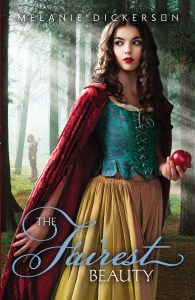
Title: The Fairest Beauty

Author: Melanie Dickerson

Series: Hagenheim/Fairy Tale Romance Series (3)

Published by Zondervan 

Year: 2012

Pages: 336 (Paperback)

Format Read: Kindle 

Language: English

ISBN: 978-0-310-72440-7

I wanted to read a fairy tale retelling, and I decided to try out this book. The Fairest Beauty is a retelling of the fairy tale, Snow White. This version of the classic fairy tale does not contain common elements of magic and fantasy; however, it has a Christian-biblical worldview.The setting is Bavaria during the Holy Roman Empire; the scenes are written as realistic historical fiction. There are several devout and pious Christians, especially the main character, Sophie. She prays frequently, reads scriptures, and often recalls what the priest told her in the past. Characters discuss forgiveness and redemption and ponder the will of God. The duchess is the mean queen, and although nothing fantastical happens when she talks to her mirror, generally, her every thought and her every action is eccentric and malevolent. Some themes and takeaways from this book are Sophie’s abuse and her desire to be loved and cherished, Gabe’s sibling rivalry, the downfall of evil (Psalm 10), and God’s protection. Finally, a happy ending (or beginning of the next chapter in life). It was great to read this Christian retelling of a fairytale. I did not know what to expect, but the book was fine. It was very creative how the author reworked the reality of this classic story.

Dates Read January to February 2021

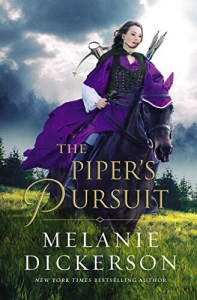
Title: The Piper’s Pursuit

Author: Melanie Dickerson

Series: Hagenheim/FairyTale Romance Series(10)

Published by Thomas Nelson

Year: 2019

Pages: 321

Format Read: Kindle 

Language: English

Several fiction recommendations appeared on my Amazon account; this novel’s plot description seemed pretty interesting so I decided to read it. This is the second book by Melanie Dickerson that I have read. It’s a reimagining of The Pied Piper of Hamelin,  and it is another young adult medieval romance fairy tale with a Christian worldview. It’s around the 14th century in the Holy Roman Empire. The heroine, Katerina, is brave and strong with a disdain for arrogant men like her stepfather and the new guy in town, Steffan, who is the Duke’s “prodigal” son. They try to work together to figure out the mysteries in town: the children disappearing, the rat infestations, the beast attacks. They eventually uncover her stepfather Hennek’s wrongdoings and the story really takes off; it’s a suspenseful adventure. Steffan and Kat learn about each other and begin to trust each other and dismantle assumptions. Katerina has to be strong because her stepfather is abusive to her and her mother; she has to be the one to protect them and handle issues. Steffan felt wronged by his place in life such as being the younger son and not getting the inheritance. In the story, it’s revealed that disobeyed his father and he feels ashamed of this. The father is a Father God figure in that he forgives his son and shows him love and mercy.

Dates Read May to August 2021