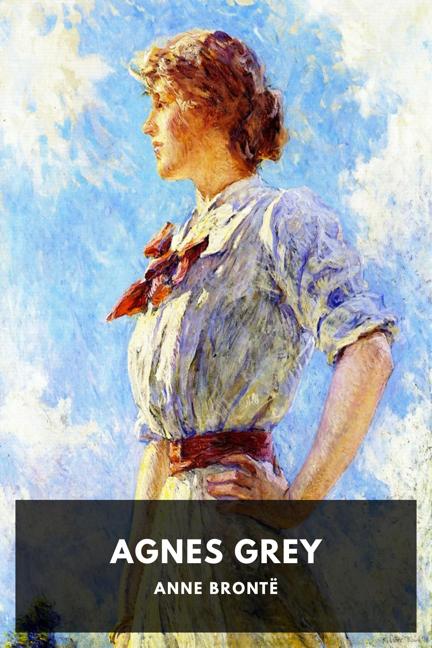
Title: Agnes Grey
Author: Anne Brontë
Edition: Standard Ebooks (2022)
Format Read: Kindle
Length: 222 pages (Kindle)
Language: English
URL: https://standardebooks.org/ebooks/anne-bronte/agnes-grey
First Published: 1847 by Thomas Cautley Newby (London)
Dates Read: 2026, April 21 to May 26
A Fresh Start
Reading through the works of the Brontës has been a desire of mine ever since I read Jane Eyre in high school. I tried to read Wuthering Heights several years ago, but for some reason, I did not finish it. I finally decided to attempt reading through the Brontë canon again. Instead of picking up where I left off, I chose to read Agnes Grey as a starting point.
Reflections
This book was wonderful, profound, and not what I expected. One of the first things I appreciated was how quickly the story gets underway. The chapter titles provide a sense of direction, and the story feels just the right length. At fewer than 230 pages in the edition that I read, the book never felt too short or too long.
What stood out most to me, however, was Agnes herself. Her inner thoughts and feelings are presented with remarkable depth, making her both believable and relatable. More than once, she reminded me of myself. Throughout the novel, Agnes reflects carefully on her actions, motives, and interactions with others. Her observations feel sincere, and her narration carries a sense of consideration for the reader. Through her descriptions, Anne Brontë paints vivid portraits of the people Agnes encounters, allowing readers to understand both the characters themselves and Agnes’s responses to them.
So much in this book reminded me of myself and of various interactions that I have had with people. I saw aspects of myself in Agnes’s awkwardness and her struggles to make herself understood. There were moments when she knew what she meant in her own mind, yet those around her perceived her words and actions differently. She often found herself unable to explain herself as clearly as she wished.
I also related to Agnes’s tendency to wonder whether or not her efforts were accomplishing anything at all. At times, she believed she was making progress, only to discover that others saw the situation differently. She would replay conversations in her mind, regret what she said or felt, then wish that she had expressed herself better. This reminded me so much of my constant battle with rumination and overthinking random past actions.
The portrayal of unruly children and indulgent parents felt surprisingly modern. Reading Agnes’s experiences often felt like reading the thoughts of a present-day teacher. Children misbehaving and parents blaming the teacher rather than addressing the behavior themselves is apparently not a new phenomenon. The novel was hilarious and tragic at the same time.
An observation I found particularly interesting was Agnes’s assumption that other children would be much like herself and her sister. She soon discovers that they are not, and that other families can act very differently from her own. I relate to that realization because I often assume that other people think, behave, and reason the way I do, only to discover that they do not.
I also appreciated Agnes’s concern that the people around her might negatively influence her character. At one point, she worries about bad company corrupting good habits, and I understood exactly what she meant. Many of the bad habits I picked up in life came from being around other people rather than from my upbringing. Public school introduced me to behaviors and attitudes that never would have occurred to me otherwise. Even now, I can relate to leaving home with a peaceful mind only to arrive at work and find myself surrounded by gossip, profanity, and unnecessary drama.
The novel has a particularly pronounced Christian worldview. I loved Agnes’s analysis on sermons, Scripture, and religious instruction. I admired the way Agnes integrates her Christian faith into her moral reflection, self-examination, and perseverance. When faced with difficulties, she continually evaluates her own conduct, considers how she might improve, and strives to endure with patience. Agnes was determined to keep trying different approaches when her efforts seemed unsuccessful. These elements do not feel forced. They naturally arise from her character and the way that she understands the world. The story also engages with themes such as scrupulosity, lack of empathy, and resilience—subjects that I have been thinking about quite a bit lately.
Because the novel is written as a retrospective first-person account, Agnes can choose what to gloss over and what to describe in detail. I assumed that the novel would remain focused primarily on Agnes’s observations of society, her efforts to remain principled, and the obstacles and hopes she encounters as a governess living away from her family. However, the narrative undergoes a tonal shift after she meets Weston, introducing a stronger romantic element. It was interesting to watch the focus of the narrative change over time.
Content Advisory
While reading through the novel, I made an effort to note some potential concerns.
Language: A few uses of d*mn or d*mned, a few uses of bl**dy, and a use of *ss as a term of insult.
Violence: Animal cruelty; unruly and destructive behavior by children.
Grief & Loss: Mentions of death, bereavement, and family grief.
Favorite Quotes
I can conceive few situations more harassing than that wherein, however you may long for success, however you may labour to fulfil your duty, your efforts are baffled and set at nought by those beneath you, and unjustly censured and misjudged by those above. (pg.38)
I have not enumerated half the vexatious propensities of my pupils, or half the troubles resulting from my heavy responsibilities, for fear of trespassing too much upon the reader’s patience; as, perhaps, I have already done; but my design in writing the few last pages was not to amuse, but to benefit those whom it might concern; he that has no interest in such matters will doubtless have skipped them over with a cursory glance, and, perhaps, a malediction against the prolixity of the writer; but if a parent has, therefrom, gathered any useful hint, or an unfortunate governess received thereby the slightest benefit, I am well rewarded for my pains. (pg.38)
I sometimes felt myself degraded by the life I led, and ashamed of submitting to so many indignities; and sometimes I thought myself a fool for caring so much about them, and feared I must be sadly wanting in Christian humility, or that charity which “suffereth long and is kind, seeketh not her own, is not easily provoked, beareth all things, endureth all things.” (pg.77)
I did hear him preach, and was decidedly pleased with the evangelical truth of his doctrine, as well as the earnest simplicity of his manner, and the clearness and force of his style. It was truly refreshing to hear such a sermon, after being so long accustomed to the dry, prosy discourses of the former curate, and the still less edifying harangues of the rector. (pg.89)
Habitual associates are known to exercise a great influence over each other’s minds and manners. Those whose actions are forever before our eyes, whose words are ever in our ears, will naturally lead us, albeit against our will, slowly, gradually, imperceptibly, perhaps, to act and speak as they do. I will not presume to say how far this irresistible power of assimilation extends; but if one civilised man were doomed to pass a dozen years amid a race of intractable savages, unless he had power to improve them, I greatly question whether, at the close of that period, he would not have become, at least, a barbarian himself. And I, as I could not make my young companions better, feared exceedingly that they would make me worse—would gradually bring my feelings, habits, capacities, to the level of their own; without, however, imparting to me their lightheartedness and cheerful vivacity. (pg.107)
Well! what is there remarkable in all this? Why have I recorded it? Because, reader, it was important enough to give me a cheerful evening, a night of pleasing dreams, and a morning of felicitous hopes. Shallow-brained cheerfulness, foolish dreams, unfounded hopes, you would say; and I will not venture to deny it: suspicions to that effect arose too frequently in my own mind. But our wishes are like tinder: the flint and steel of circumstances are continually striking out sparks, which vanish immediately, unless they chance to fall upon the tinder of our wishes; then, they instantly ignite, and the flame of hope is kindled in a moment. (pg.170)
He had not breathed a word of love, or dropped one hint of tenderness or affection, and yet I had been supremely happy. To be near him, to hear him talk as he did talk, and to feel that he thought me worthy to be so spoken to—capable of understanding and duly appreciating such discourse—was enough. (pg.180)
 A Love So Wordy